Assistant manager in bank

How to Become an Assistant Manager in a Bank and What Salary Can You Expect?

Overview

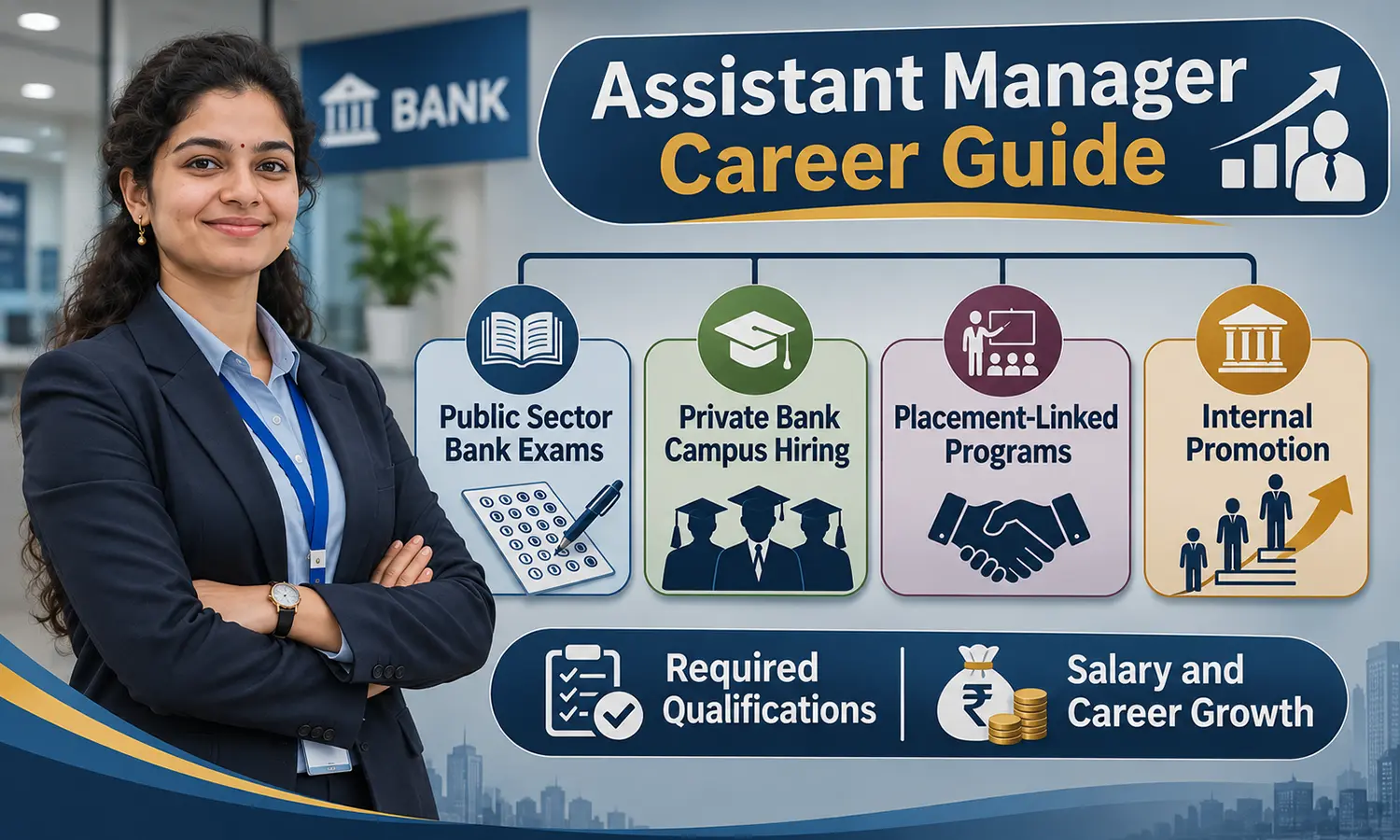
To become an assistant manager in bank roles, you need a graduate degree and one of four routes. These are a public sector officer exam, campus hiring, a placement-linked training program or internal promotion. In public sector banks, the starting basic pay is ₹48,480 a month plus allowances, while private bank pay depends on the bank, city and department.

What the Assistant Manager Title Means in Indian Banks

In public sector banks, the role is an officer post in Junior Management Grade Scale I, often called JMGS-I. In private banks, it is an internal grade one or two steps above an officer or executive. Either way, the assistant manager in bank title marks the first real supervisory level.

Assistant Manager Roles and Responsibilities in Bank Departments

The core assistant manager roles and responsibilities in bank settings depend on the function you join.
Department Typical Responsibilities
Branch operations
Cash and vault control, account opening checks, daily reports and audit readiness
Driving deposit and loan targets with a small team of officers
Appraising loan files, checking documents and tracking repayments
Handling escalations and keeping complaint turnaround within limits
Compliance
Monitoring KYC, AML alerts and regulatory reporting
Recruiters judge candidates on how quickly they can take on these assistant manager roles and responsibilities in bank branches, especially team supervision and audit discipline.

Assistant Manager in Bank Qualification

The basic assistant manager in bank qualification is graduation in any discipline from a recognised university. Each route then adds its own filters.
  • Public sector exams such as IBPS PO require candidates to be between 20 and 30 years old, with relaxations for reserved categories
  • Communication in English and the local language is tested in interviews for almost every route
Meeting the assistant manager in bank qualification is only the first filter, so plan preparation around the route you choose.

How to Become Assistant Manager in Bank Through Four Routes

Graduates who search how to become assistant manager in bank usually find four realistic paths.

Route 1: Through Public Sector Officer Exams

Clear IBPS PO, SBI PO or a specialist officer exam, complete the probation period and get confirmed in JMGS-I. IBPS announced 5,208 PO vacancies for the 2025 cycle against lakhs of applicants, so preparation often takes a year or more.

Route 2: Through Campus Hiring

Private banks hire trainees and officers from colleges who later move into the grade.

Route 3: Through Placement-Linked Programs

Pre-hire programs teach banking products, compliance and customer handling, then connect graduates with partner banks without exam cycles.

Route 4: Through Internal Promotion

Officers who hit targets with clean audit records get promoted into the grade.
If job security matters most, the exam route fits. If speed matters more, the private routes answer how to become assistant manager in bank faster.

Assistant Manager Salary in Bank in 2026

The assistant manager salary in bank jobs differs sharply between public and private sector banks.

Public Sector Pay Structure

The JMGS-I pay scale published in IBPS PO notifications starts at a basic pay of ₹48,480 a month and rises through annual increments to ₹85,920. Dearness allowance, house rent allowance or leased accommodation and special allowance are added on top. Medical benefits and concessional staff loans add long-term value.

Private Sector Pay Structure

Private banks set their own salary bands. Pay varies by bank, city and department. Sales-facing roles often add target-linked incentives to fixed pay. Freshers entering at officer level through placement-linked programs often start around ₹3.5 lakh a year plus incentives, as listed by SRM School of Banking. Your assistant manager salary in bank roles then grows with ratings and promotions.

Where to Track an Assistant Manager Bank Vacancy

Public sector openings appear through official notifications on the IBPS and SBI websites. Public sector bank headcount rose to 7,57,641 in FY25 as per RBI data reported by the media.
Private banks post openings on careers pages and through campus drives or authorised training partners. Every genuine assistant manager bank vacancy comes from the bank or its official partner and never asks candidates for an application fee. Set alerts on official sites so you never miss an assistant manager bank vacancy that matches your profile.

Build Your Route Into Private Banking With SRM School of Banking

For graduates who prefer the private sector route, the Placement Assured Program at SRM School of Banking builds core banking knowledge, compliance basics and customer handling through classroom learning and supervised on-the-job training. It shortens the path from graduation to your first officer role and then to an assistant manager in bank grade. You can apply to SRM School of Banking for the next intake.

Key Takeaways

  • An assistant manager in bank branches supervises operations, sales or credit work under a senior manager
  • Graduation is the base qualification, with an age limit of 20 to 30 years for IBPS PO
  • Exams, campus hiring, placement-linked programs and internal promotion are the four main routes
  • Public sector basic pay starts at ₹48,480 a month and rises to ₹85,920 through increments
  • Track vacancies only on official bank and IBPS websites or through authorised partners

Your Next Step Toward a Bank Officer Career

Becoming an assistant manager in bank branches starts with picking the right route and preparing for its selection process. Public sector roles offer structured pay and security, while private banks offer faster entry and performance-linked growth. Graduates who build banking skills early reach the grade sooner.
So, contact SRM School of Banking, which helps you start that journey with training and hiring access in one program.

FAQs

You need a graduate degree in any discipline from a recognised university. Public sector exams such as IBPS PO also set an age limit of 20 to 30 years. Private banks may prefer commerce or management graduates. Strong communication skills are expected on every route.

Through the public sector route you join JMGS-I after clearing the PO exam and a probation that usually lasts two years. In private banks, officers often reach the grade after one to three years of steady performance. Training before joining can shorten this.

In public sector banks the starting basic pay is ₹48,480 a month plus allowances. Gross pay depends on city of posting and current DA rates. Private bank pay varies by bank and department, with incentives in sales roles.

Yes, private banks hire through campus drives, placement-linked programs and internal promotion. You usually join at officer level and move up on performance. Pre-hire training helps you clear interviews and settle faster.

In public sector banks a PO is recruited into JMGS-I and works as an assistant manager after probation. In private banks the two are separate grades with different entry routes. Check the grade and reporting line in your offer letter.

Select the fields to be shown. Others will be hidden. Drag and drop to rearrange the order.
  • Image
  • SKU
  • Rating
  • Price
  • Stock
  • Availability
  • Add to cart
  • Description
  • Content
  • Weight
  • Dimensions
  • Additional information
Click outside to hide the comparison bar
Compare