Business Communication Skills for Banking

Business Communication Skills for Banking

In any professional setting, the way you share information often matters as much as the information itself. Strong business communication skills help ideas travel clearly between people, teams, and departments. They reduce errors, speed up decisions, and shape how others see you. This article explains what business communication involves, the main forms it takes, and the practical habits that help any professional communicate with clarity and confidence at work.

What Business Communication Skills Involve

Business communication skills are the abilities used to exchange information in a work environment in a clear and professional way. They cover how you speak in meetings, how you write emails, and how you present ideas to a group. The aim is always the same, which is to be understood quickly and correctly.

Unlike casual chat, workplace communication carries consequences. A poorly worded message can delay a project or confuse a client, so precision and tone both matter a great deal.

The Main Types of Communication Skills

To improve at work, it helps to know the types of communication skills you use every day. Each type plays a role, and strong professionals develop all of them.

  • Verbal communication used in meetings, calls, and discussions
  • Written communication used in emails, reports, and messages
  • Non verbal communication shown through posture, tone, and expression
  • Visual communication used in charts, slides, and simple diagrams

Balancing these types makes your message stronger. A clear spoken update supported by a simple chart lands far better than words alone. Awareness of each type lets you choose the right tool for each situation.

Why Presentation Skills Matter

Few business abilities stand out as much as the power to present well. Good presentation skills let you hold attention, explain a plan, and persuade a room. They turn a nervous speaker into a trusted voice.
Many professionals build a presentation skills ppt to organise their thoughts before they speak. A clear slide deck supports your message, but the real skill lies in how you deliver it. Speak to the audience, keep slides simple, and let your confidence carry the room.

Writing Clearly in English

Most workplace communication today happens in writing, which makes strong communication skills in English a major asset. Clear writing respects the reader’s time and prevents confusion across teams and clients.
Keep sentences short, lead with the main point, and avoid heavy jargon. A well written message gets a faster and better response than a long, tangled one. Practising this habit lifts the quality of every email you send.

Linking Communication and Personality

How you communicate is closely tied to how you carry yourself. The link between communication skills and personality development is strong, because confidence, warmth, and clarity grow together. A polished communicator usually has a polished presence.

Working on both at once creates a powerful effect. As your communication improves, your confidence rises, and as your confidence rises, your communication becomes more natural. The two feed each other in a positive cycle.

Habits That Sharpen Workplace Communication

Strong communicators rely on simple, repeatable habits. They prepare before important conversations, they listen before they reply, and they confirm that their message was understood. These habits prevent most workplace misunderstandings.
Adopt one habit at a time and let it become natural before adding another. Over weeks and months, these small routines build into a confident and reliable professional style.

Communication as a Career Asset

In a busy workplace, the people who communicate clearly often move ahead fastest. Strong business communication skills make you easier to work with, easier to trust, and easier to promote. They are an investment that pays off at every stage of a career.

Communicating in Virtual Meetings

Much of today’s work happens over video calls, which bring their own demands. Strong business communication skills in a virtual setting mean speaking clearly, looking at the camera, and keeping your message short. Weak audio and long monologues lose an online audience quickly.
Prepare before you join, mute when you are not speaking, and use simple visuals to support your points. These small habits make you appear professional and easy to follow, even through a screen.

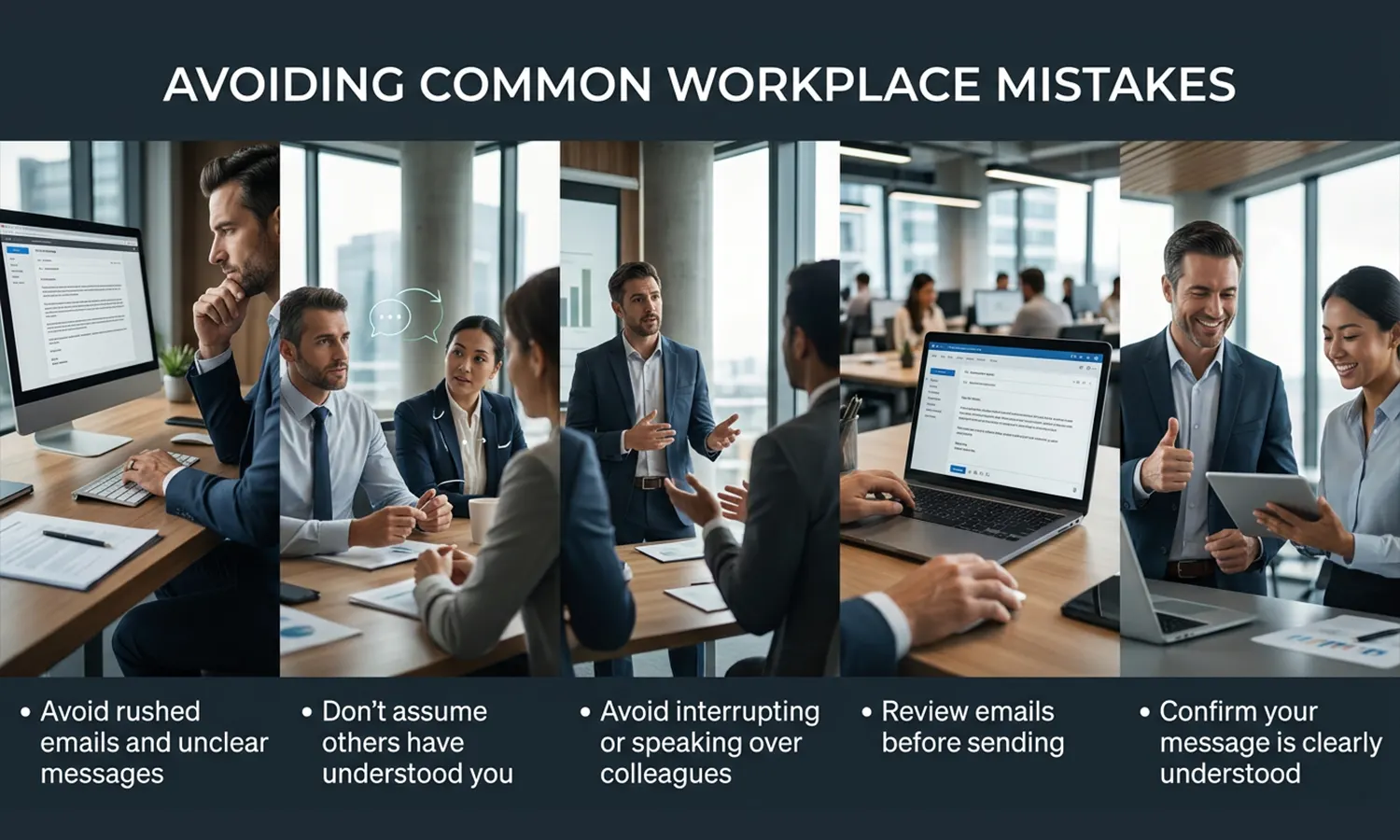
Avoiding Common Workplace Mistakes

Business Communication Skills for Banking
Even skilled professionals fall into communication traps. Sending a rushed email, assuming others understood, or speaking over a colleague all create friction. Spotting these habits is the first step to removing them.
Make a short habit of reading an email once before you send it and confirming that your spoken message landed. These checks take seconds and prevent many of the misunderstandings that slow a team down.

The Confidence Factor

Confidence shapes how your message is received. The same words delivered with calm assurance carry far more weight than words spoken with hesitation. This is why communication skills and personality development are best built side by side.
Confidence grows through preparation and practice. The more you rehearse and the better you know your subject, the more naturally your confidence shows when it counts.

Adapt Your Message to the Listener

Great communicators adjust their message to suit each audience. The way you explain a product to a young customer may differ from how you explain it to a senior one. Reading the listener and adapting your words is a hallmark of strong business communication skills.

Practice this by noticing how your audience responds and changing your pace or vocabulary in real time. This flexibility makes your message land more often and marks you as a thoughtful professional.

Clear writing also saves the whole team time. When a message is easy to read and act on, colleagues respond faster and with fewer questions. Treating every email and report as a chance to be clear is a simple habit that lifts the performance of everyone around you.

Begin with the area that feels weakest, whether that is writing, speaking, or presenting, and improve it step by step. To keep developing your communication and professional skills for the BFSI sector, visit srmsb.com for more.

FAQs

Business communication skills are the abilities used to exchange information at work in a clear and professional way. They cover speaking in meetings, writing emails, and presenting ideas to a group.
The main types of communication skills are verbal, written, non verbal, and visual. Strong professionals develop all four and choose the right one for each situation.
Presentation skills let you hold attention, explain a plan, and persuade a group. Many professionals build a presentation skills ppt to organise their points, but the real skill lies in clear delivery.
Communication skills and personality development grow together. As your communication improves, your confidence rises, and as your confidence rises, your communication becomes more natural.
To strengthen communication skills in english at work, keep sentences short, lead with the main point, and avoid heavy jargon. Clear writing earns faster and better responses from colleagues and clients.
Select the fields to be shown. Others will be hidden. Drag and drop to rearrange the order.
  • Image
  • SKU
  • Rating
  • Price
  • Stock
  • Availability
  • Add to cart
  • Description
  • Content
  • Weight
  • Dimensions
  • Additional information
Click outside to hide the comparison bar
Compare