
Key Takeaways
- Bank salary for freshers usually changes by role more than by degree.
- For many roles, bank salary for freshers includes incentives, not just fixed pay.
- The fastest way to improve a bank's salary for freshers is better interviews + role readiness.
- With training, bank salary for freshers can start closer to higher slabs in some programs.
- Growth is quicker when you choose the right starting role in the bank salary for freshers plans.
Overview of Bank Salary for Freshers in India After a Banking Course
In private banks, freshers often start in the range of about ₹2.2 LPA to ₹3.6 LPA, depending on role, city, and profile. When exploring bank job fresher salary options, your starting pay also changes based on a fixed salary vs an incentive-linked salary. Sales and field roles may show a smaller fixed component but a higher earning chance through incentives.
(Quick note: When people say “bank employee salary,” they usually mean total yearly pay, but HR may talk in monthly fixed + incentives.)
Role-Wise Bank Salary for Freshers With Banking Training
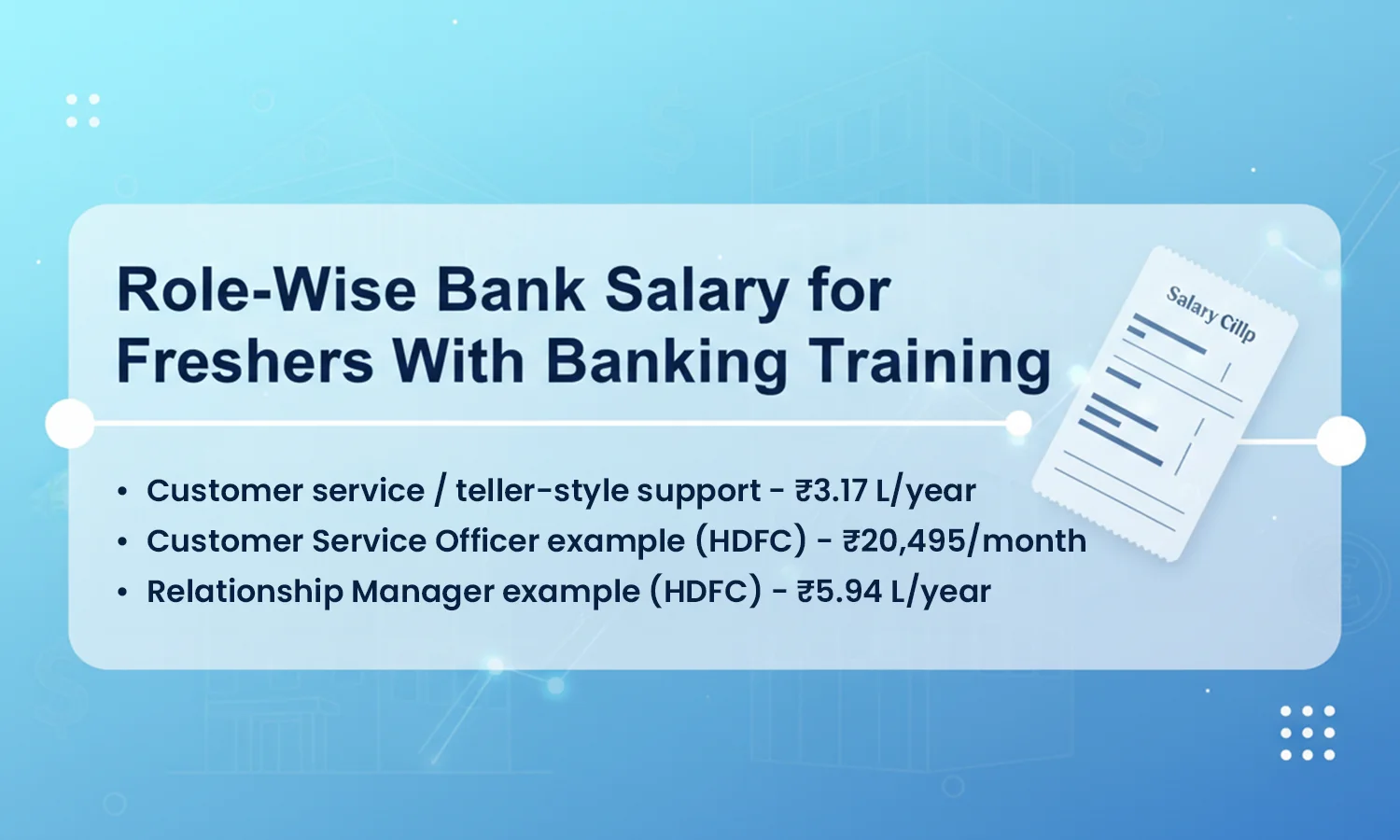
- Customer service / teller-style support: A teller-customer service role average is reported around ₹3.17 lakh/year in India (range varies by factors like location).
- Customer Service Officer example (HDFC): Glassdoor shows an estimated ₹20,495/month for Customer Service Officer at HDFC Bank (India).
- Relationship Manager example (HDFC): Indeed estimates around ₹5.94 lakh/year for a Relationship Manager at HDFC Bank in India.
How a Banking Course Improves Starting Salary for Freshers
This is also why private bank salary for freshers can vary widely, even for newcomers. Two people can join the same bank, but at different roles and packages because one is more interview-ready.
Entry-Level Bank Jobs You Can Get After Completing a Banking Course
After training, freshers usually target roles like: branch support, customer service officer, relationship executive, operations support, and sales support. These Private bank jobs are often filled through direct interviews and hiring drives, especially when banks need fast onboarding.
One more thing: if you prefer a desk role, operations and processing can be a steady start. If you are comfortable with targets, sales roles may offer a higher overall bank job fresher salary through incentives.
Salary Growth and Career Progression for Freshers With Banking Courses
In banking, growth often follows performance and consistency. Many freshers start with smaller roles, then move into higher-value portfolios or leadership tracks. In partner-based models, some programs even publish starting pay. For example, Mahindra Finance’s SRM School of Banking partner page lists a starting salary of 3.5 LPA for specific roles, along with a one-month online training program and a stated fee.
(Also, private bank salary for freshers can rise faster when you move from service/support into relationship or revenue roles, because incentives and performance-linked bank employee salary components become bigger.)

