: AI transforming modern banking

What Is the Future of AI in Banking and How Is It Transforming the Banking Sector?

Overview

The future of AI in banking points to faster service, real-time fraud checks, quicker loan decisions and leaner back offices. AI is already changing how Indian banks serve customers, manage risk and run operations. The next phase will depend on trusted data, clear regulation and staff trained to work alongside these systems.

What the Future of AI in Banking Looks Like

In simple terms, artificial intelligence in banking means software that learns from data to predict, decide or respond. A fraud model spots unusual payments. A credit model scores a loan applicant. A chatbot answers routine queries at midnight.
The future of artificial intelligence in banking moves these tools from isolated pilots to the core of every process. Banks will use AI to decide which customer needs a call, which payment needs a second look and which loan file can be cleared in minutes.

The Numbers Driving the Shift

Global research shows why banks are investing. McKinsey estimates that generative AI could add between $200 billion and $340 billion in value to the global banking industry every year, mostly through productivity gains.
India’s payment volumes make AI a necessity. The country recorded 24.51 billion UPI transactions in August 2026 as per NPCI data. Monitoring that scale for errors and fraud is impossible without machine learning, which makes the future of AI in banking sector operations closely tied to digital payments.

The Role of AI in Banking Today

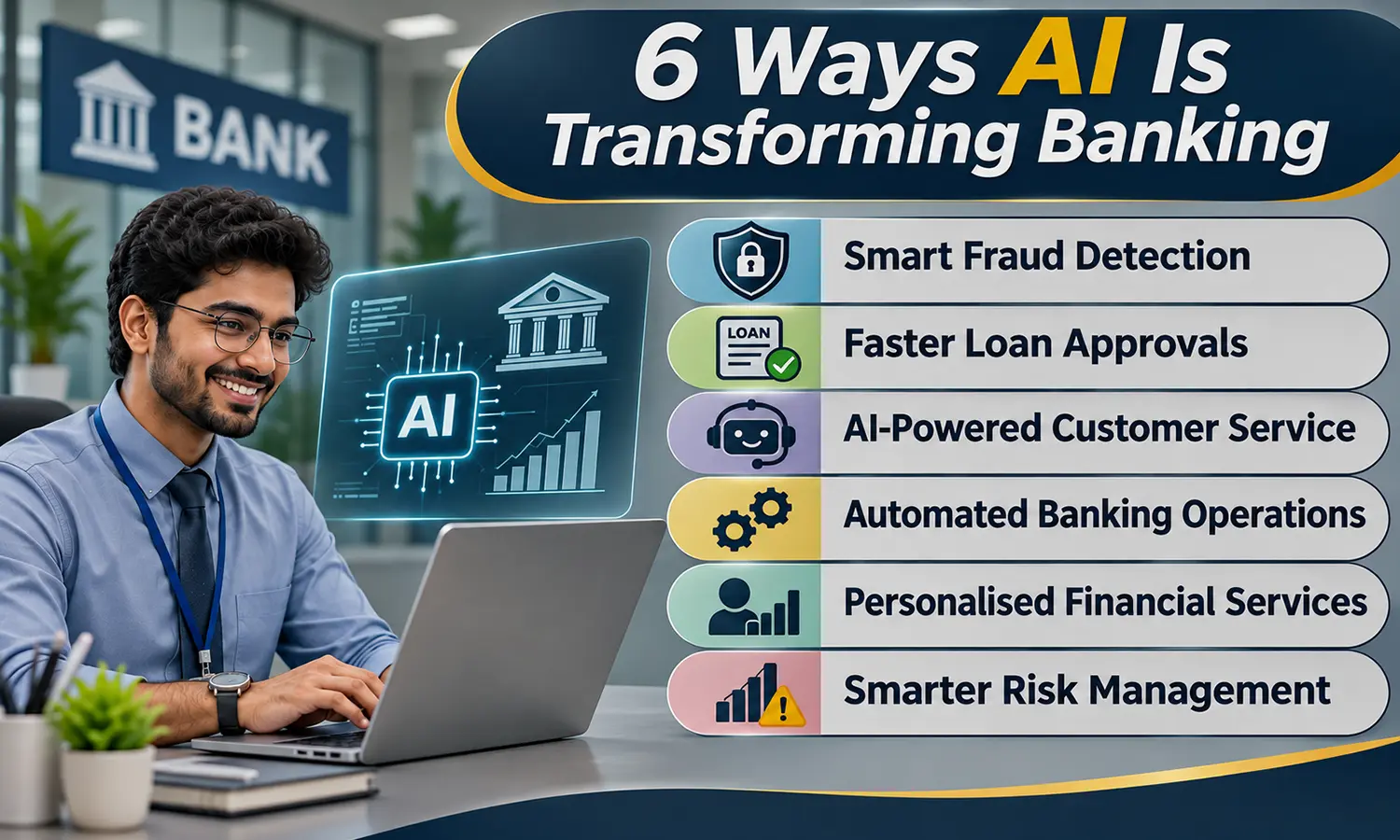
The current role of AI in banking spans five areas that touch almost every customer.

Customer Service

Chatbots handle balance checks, card blocks and routine queries around the clock, leaving complex complaints to human agents.

Credit and Lending

Models analyse bank statements, repayment history and cash flows to speed up loan approvals. Small borrowers with thin credit files can get faster decisions.

Operations

Document tools read KYC papers and loan forms while reconciliation bots match thousands of entries in minutes.

Personalisation

CRM systems suggest the right product for each customer based on behaviour and life stage. Branch staff start their day with these prompts.

Risk and Compliance

AI flags unusual patterns for anti-money laundering checks and helps compliance teams prioritise alerts.
AI applications in banking

AI in Banking Fraud Detection

Fraud is where AI delivers the most visible value. RBI data showed 23,953 bank fraud cases in FY25 involving ₹36,014 crore. Card and internet frauds made up 56.5 percent of all cases, which shows how digital channels have become the main target.
AI in banking fraud detection works by learning normal behaviour for each customer and device. When a payment looks out of pattern, the system can block it, ask for extra verification or alert an analyst within seconds.
The Reserve Bank Innovation Hub built MuleHunter.AI to identify mule accounts used to move stolen money. As of December 2025, 23 banks had implemented it according to an RTI response. Wider adoption of AI in banking fraud detection tools like this will be one of the biggest shifts in the next few years.

How Regulation Is Shaping What Comes Next

Banks cannot adopt AI without guardrails. In August 2025, the RBI released the FREE-AI framework for responsible and ethical AI in the financial sector. It rests on seven principles called Sutras and carries 26 recommendations covering governance, fairness, accountability and consumer protection.
India’s Digital Personal Data Protection Act, 2023 adds rules on how customer data is collected and used. Together, these shape the future of artificial intelligence in banking in India, where explainability and customer consent will matter as much as accuracy.

Future of AI in Banking and Finance Beyond Banks

The future of AI in banking and finance extends to NBFCs, insurers and wealth platforms. NBFCs use AI to underwrite small loans quickly. Insurers use it to price policies and check claims. Investment platforms use it to suggest portfolios based on goals.
The future of AI in banking and finance rewards professionals who combine domain knowledge with comfort using data tools.

Challenges Banks Still Need to Solve

  • Bias in models that could treat some customer groups unfairly
  • Data quality gaps that lead to wrong predictions
  • Explainability, since customers and regulators need clear reasons for decisions
  • Cyber risks that grow as systems become more connected
  • Skill gaps among staff who must supervise AI outputs
Solving these will decide how quickly the future of AI in banking sector plans turn into everyday practice.

What This Means for Banking Professionals

Routine tasks will shrink while roles in fraud analysis, digital banking, risk and advisory grow. Every banker will need basic data literacy and an understanding of how AI decisions are made.
SRM School of Banking helps on both sides of this change. Its Corporate Program delivers training solutions directly to banks that want to upskill teams for AI-enabled work. For graduates, the Placement Assured Program covers digital banking and fintech fundamentals alongside core banking, with hiring access to private banks.

Key Takeaways

  • The future of AI in banking centres on faster service, real-time fraud checks and quicker lending
  • AI already supports customer service, credit, operations, personalisation and compliance
  • RBI data showed 23,953 fraud cases in FY25, with card and internet frauds forming 56.5 percent of cases
  • RBI’s FREE-AI framework and India’s data protection law set the rules for responsible use
  • Professionals with banking knowledge and data literacy will lead the next phase

Preparing for an AI-Powered Banking Sector

The future of AI in banking is already visible in faster payments, smarter fraud checks and quicker service. Banks that pair technology with trained people will move ahead, while those that ignore skills will struggle to keep up.

SRM School of Banking helps graduates and bank teams build the knowledge this new banking sector demands. Get in touch with SRM School of Banking today and learn more about the programs it offers.

FAQs

Indian banks will use AI across service, lending, fraud control and operations. Payment volumes are too large to manage without it. The RBI’s FREE-AI framework will guide responsible adoption. Customers can expect faster decisions with stronger protection.

AI models learn each customer’s normal behaviour and flag unusual payments in real time. Tools like MuleHunter.AI help banks find accounts used to move stolen money. Human analysts still review the flagged cases.

AI will take over repetitive tasks such as data entry and basic queries. Roles that need trust, judgement and complex problem solving will remain human-led. New roles are growing in fraud analysis, digital banking and risk. Staff who learn to work with AI tools stay valuable.

Key risks include biased models, poor data quality, cyber threats and decisions that are hard to explain. Regulators expect banks to manage these through governance and testing. Customer consent and data privacy are also central.

Banks should map which tasks AI will handle and retrain staff for higher value work. Training on digital tools, fraud awareness and customer advisory helps teams adapt. Managers need skills to supervise AI-supported workflows. Structured external programs can speed up this shift.

Select the fields to be shown. Others will be hidden. Drag and drop to rearrange the order.
  • Image
  • SKU
  • Rating
  • Price
  • Stock
  • Availability
  • Add to cart
  • Description
  • Content
  • Weight
  • Dimensions
  • Additional information
Click outside to hide the comparison bar
Compare