
How to Become a Bank Manager in India

How to Become a Bank Manager in India: Exams and Steps

Overview

Here is how to become a bank manager in India. Complete a graduation degree, clear a recruitment exam such as IBPS PO or SBI PO or join a private bank, and then build experience in credit, sales and operations. Promotions, internal exams, and certifications move you toward the manager post.

How to Become a Bank Manager Through Education

The bank manager qualification starts with a graduation degree, and most recruitment notices accept any discipline. Commerce, economics, and management help, but they are not compulsory. IBPS PO sets an age band of 20 to 30 years with relaxations for reserved categories.

Beyond the degree, certifications from the Indian Institute of Banking and Finance, such as JAIIB and CAIIB, support later promotions. Good communication and sound numerical sense count at every stage.

Patience helps on this road. Many managers spent five to ten years moving from one role to the next, picking up skills in each. Treat early roles as training and look for chances to handle loans, audits, or sales.
Preparation should begin early. Final year students can start building aptitude and reading banking news well before the degree result arrives.

Which Bank Manager Exam and Course Should You Choose?

The common bank manager exam routes are IBPS PO and SBI PO, which have prelims, mains, and interview stages. These recruit probationary officers who rise toward manager posts over time. Private banks have their own tests and interviews.
A bank manager course can help with exam preparation or with job readiness for private banks. Look at the syllabus, practice tests, and placement support rather than only the brochure.
Documents decide many outcomes. Keep your mark sheets, identity proof, photographs, and category certificates ready, because last-minute searches cause mistakes. Many candidates lose a year over a small paperwork error.

Take sectional tests and full mocks every week once the basics are clear. These tests show if your speed matches the exam.

How Does Bank Manager Recruitment Work?
How Does Bank Manager Recruitment Work
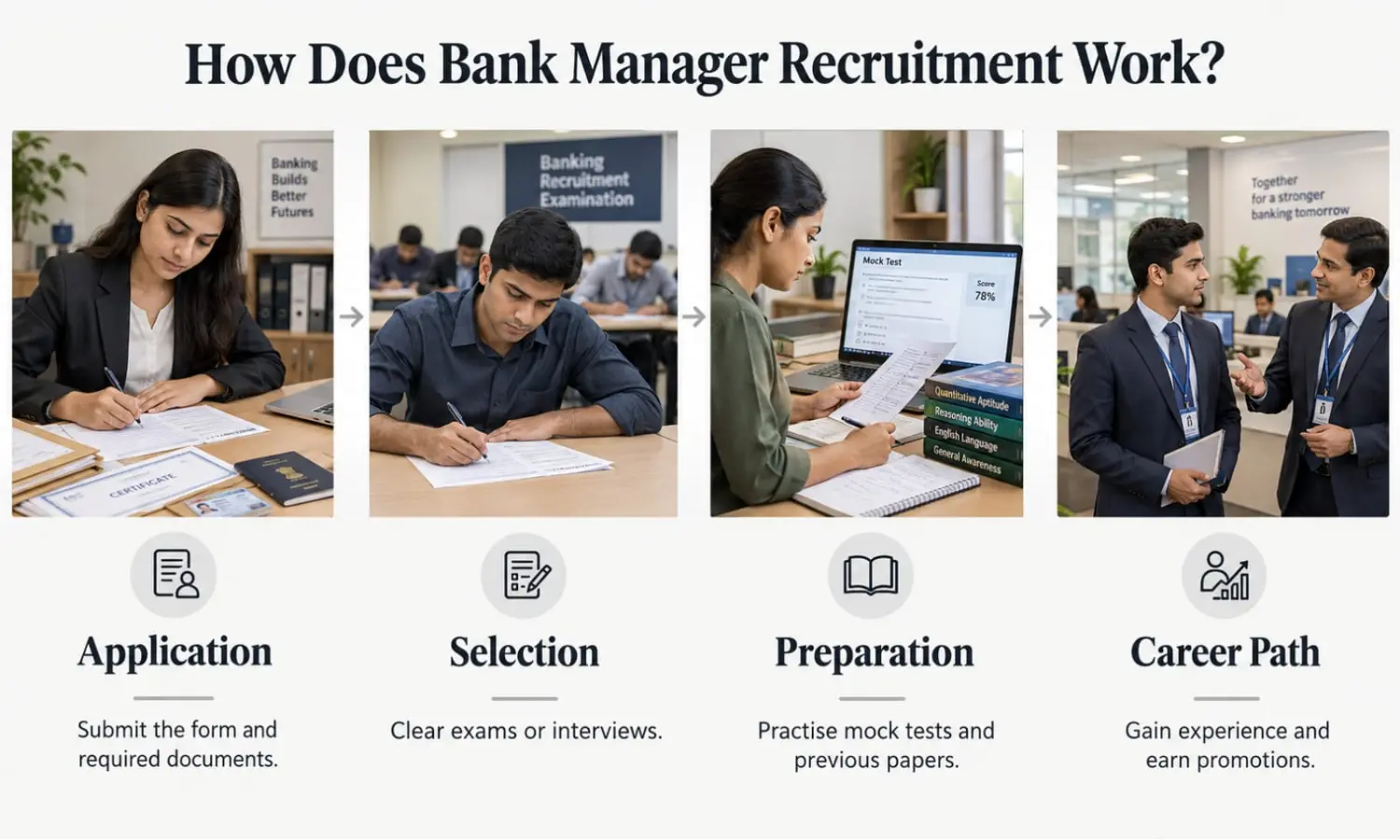
A clean application to bank manager posts starts with a short, accurate resume and the right documents ready. Read each notification for age limits, fees, and dates, since a small error can cancel the form.
Bank manager recruitment differs by bank. Public sector banks use common exams, while private banks run campus drives and direct interviews. Many people also reach managerial posts through internal promotion after years in clerical or officer roles.

Mock tests and previous papers should be part of every plan. They show how the sections work, where time slips away and which topics need extra practice. Review each test carefully so the same errors do not repeat.

Bank Manager Skills and Salary

Strong bank manager skills include leadership, customer handling, ethical judgement, etc. These grow through real work, so early roles in branch operations and sales matter.
Bank manager salary depends on several factors. It is always best to verify the latest official details instead of relying on a single quoted number.
Finally, stay updated on banking news, interest rates, and RBI announcements. Interview panels expect officers to understand what is happening in the sector, and managers use this awareness every day with customers.
Private banks may reward strong sales results quickly, while public sector banks follow a structured timeline. Pick the model that fits your temperament and goals.

Start Now on the Road to Branch Leadership

If you are asking how to become a bank manager, begin with the right first job. SRM SB (School of Banking) offers a Placement Assured Program for graduates from any discipline, covering core banking, sales, compliance and interview readiness. Roles such as relationship manager and business development officer build the experience that managers need. Apply today at SRM SB to take your first step.

Key Takeaways

  • Learning how to become a bank manager starts with a graduation degree and a clear route.
  • IBPS PO, SBI PO, and private bank hiring are the main entry paths.
  • Certifications such as JAIIB and CAIIB support promotion.
  • Leadership, credit knowledge, and ethics grow through branch experience.
  • Check official notices for pay scales and eligibility before applying.

FAQs

Complete a graduation degree in any discipline and choose a route, such as a PO exam or private bank hiring. This is the starting point for every route, since every route asks for a degree first.
The path usually takes several years of experience after joining as an officer or clerk. The timeline depends on exam clearance, performance, and promotion cycles in your bank. Strong results and steady learning usually shorten the wait between each step.
Yes. Most notifications accept graduates from any discipline. Learning how to become a bank manager is about exams, skills, and experience, and not about your original subject. Banking basics can be learned through short courses.
It depends on your goals. Private banks may move faster for strong sales performers, while public banks offer structured promotion. Both are valid ways of understanding how to become a bank manager.
Communication, numerical comfort, honesty, and leadership help most, and each can be practised from the first day in a branch. Anyone on this path should also learn credit basics, compliance rules, and customer handling during early roles.
Select the fields to be shown. Others will be hidden. Drag and drop to rearrange the order.
  • Image
  • SKU
  • Rating
  • Price
  • Stock
  • Availability
  • Add to cart
  • Description
  • Content
  • Weight
  • Dimensions
  • Additional information
Click outside to hide the comparison bar
Compare