

corporate executive

What a Corporate Executive Does and How the Role Compares

Overview

A corporate executive is a professional who manages business, operations or strategy within a company, usually at a level above an entry role. The term covers a range of positions that keep an organisation running and growing. It builds on the same foundation as any business executive career.

The title corporate executive sounds grand, and it often carries real responsibility. Yet the role grows from the same roots as any executive job, serving customers and driving business. For a graduate mapping out a career, it helps to understand where a corporate executive sits and how you reach that level.

Understanding the term early lets you aim in the right direction. Let us break down the meaning, the work and how it compares to a standard executive role.

What Is a Corporate Executive?

The corporate executive meaning points to a professional who manages part of a company at an organisational level. This can cover operations, strategy, sales leadership or administration. A corporate executive usually has more responsibility than an entry-level role and helps steer how the company works.
The word corporate simply means the role operates at company level rather than a single desk. A company executive and a corporate executive often mean the same thing, someone who helps run the organisation.

Corporate Executive vs Business Executive
corporate executive
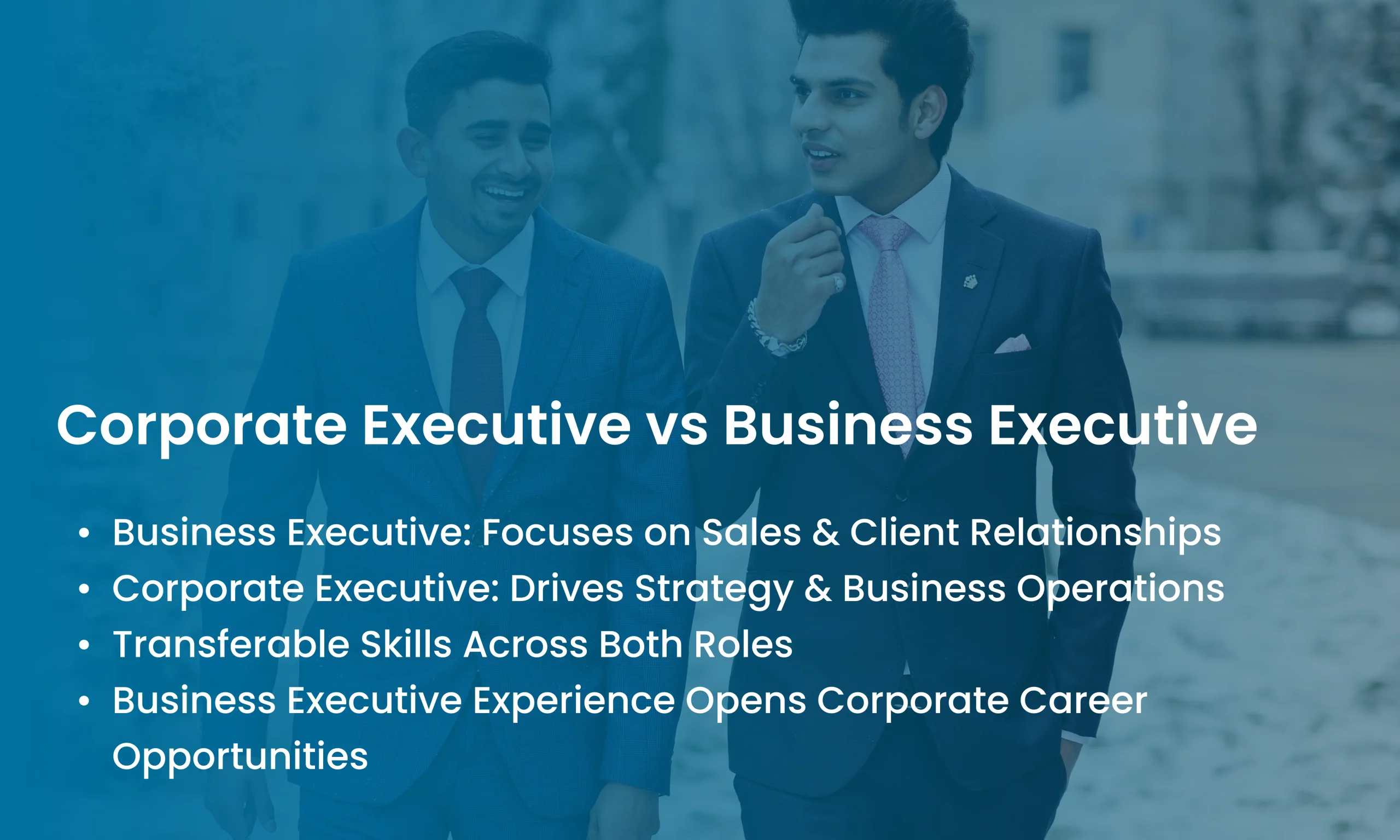
People often ask how this differs from a standard role. A business executive usually handles clients, sales and daily growth tasks. A corporate executive tends to operate at a wider level, guiding strategy or managing a function across the company.

In practice, the two overlap. Many professionals move from the role of business executive work into corporate roles as they gain experience. The core skills carry over, so a strong start as an executive sets you up for corporate positions later.

Types of Corporate Executive Roles

Corporate roles come in several forms. Knowing them helps you target the right path as your career grows.
Role Focus
Operations executive
Keeping company processes running well
Sales leadership
Guiding a team toward revenue targets
Strategy executive
Planning how the company grows
Administrative executive
Managing key internal functions
Each of these builds on the same base of communication, judgement and business sense. Strong performers move into these roles from client-facing positions over time.

Can You Start Online?

Yes. Many corporate functions now run online or in hybrid form, so an online business executive can grow toward corporate work without being tied to one office. Technology and financial services in particular offer flexible paths into these roles.
It helps to know that the word corporate is used loosely in India. Some firms call a mid-level manager a corporate executive, while others reserve the title for senior leadership. When you read a job post, look past the title and check the actual duties, since that tells you the real level far better than the name does.
The pay reflects this range too. An entry-level corporate executive role sits close to standard executive pay, while senior positions earn significantly more. As you gain experience and results, moving up this ladder becomes a realistic goal rather than a distant one.

Key Takeaways

  • A corporate executive manages business, operations or strategy at the company level.
  • The corporate executive meaning overlaps with a company executive, someone who helps run the organisation.
  • A business executive handles clients and daily growth, while corporate roles operate at a wider level.
  • Many professionals move from the role of business executive work into corporate roles over time.
  • Online and hybrid options let you grow toward corporate work from almost anywhere.

Build Toward a Corporate Career

A corporate executive career usually starts with a strong client-facing role. The sooner you build core skills, the sooner you can grow into wider, higher-responsibility positions.
SRM School of Banking helps graduates lay that foundation. Its outcome-based, placement-focused programmes build the communication, sales and business skills that carry from entry roles into corporate ones, through live practice and on-the-job training. To start a business executive career with room to grow, see SRM School of Banking’s placement-assured programmes and aim higher from day one.

FAQs

The corporate executive meaning points to a professional who manages business, operations or strategy at the company level. A corporate executive usually carries more responsibility than an entry role and helps steer how the organisation works. The term overlaps with a company executive, and both build on the same foundation as any business executive career.

A business executive usually handles clients, sales and daily growth tasks, while a corporate executive operates at a wider level, guiding strategy or managing a function across the company. The two overlap, and many professionals move from the role of business executive work into corporate roles as they gain experience, since the core skills carry over.

Most corporate executive careers start with a strong client-facing role, then grow through consistent results and rising responsibility. Build communication, sales and business skills first, deliver on targets, and take on wider work when offered. A strong start as a business executive sets you up well, since the same core skills carry into corporate positions.

Select the fields to be shown. Others will be hidden. Drag and drop to rearrange the order.
  • Image
  • SKU
  • Rating
  • Price
  • Stock
  • Availability
  • Add to cart
  • Description
  • Content
  • Weight
  • Dimensions
  • Additional information
Click outside to hide the comparison bar
Compare