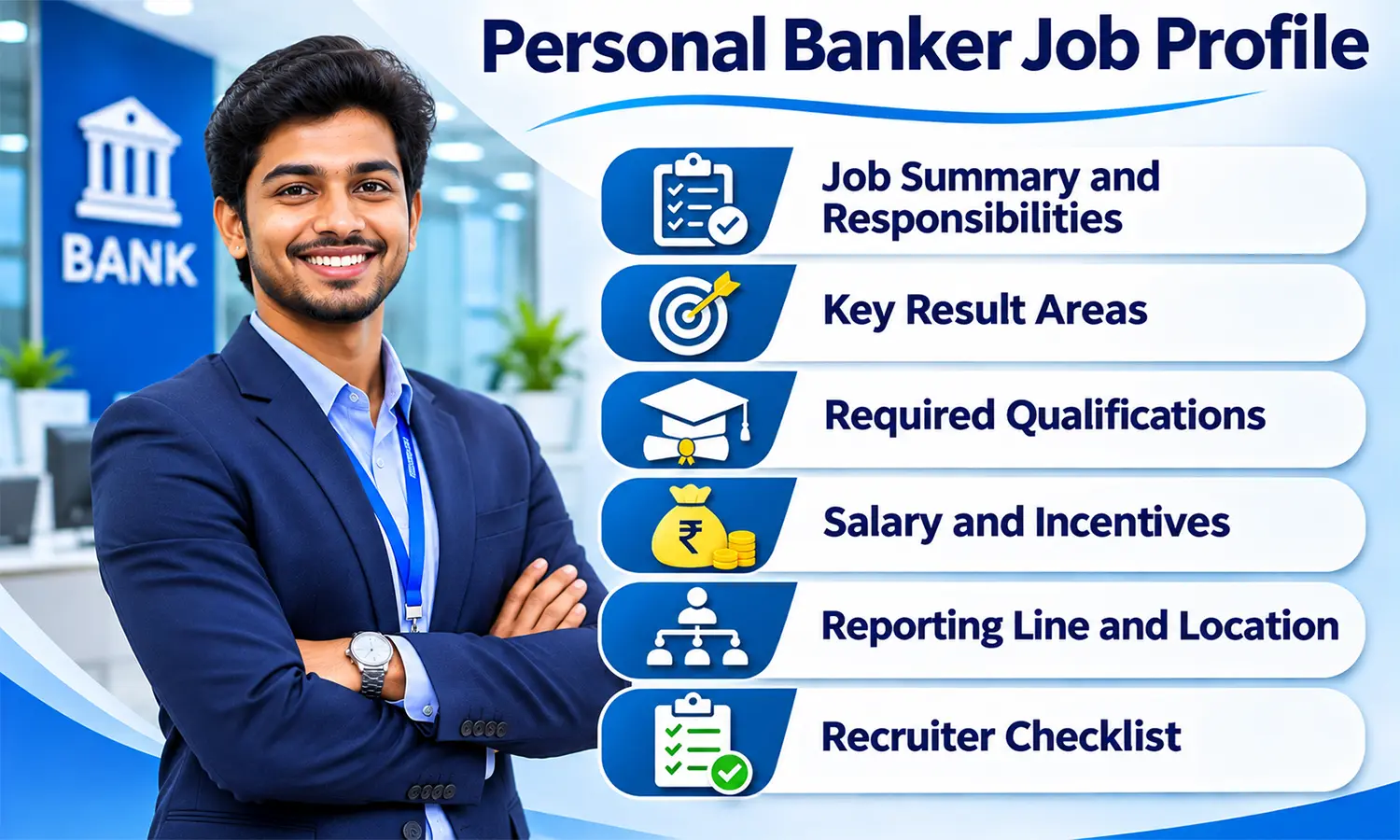

Personal banker job description

Personal Banker Job Description, Duties, Salary and Qualifications

Overview

A personal banker job description lists the role summary, reporting line, key result areas, eligibility and pay structure a bank expects. Reading it closely shows how you will be measured, which skills to highlight and how to judge an offer before you apply.

Why a Job Posting Deserves a Second Read

Most applicants skim a posting for salary and location. Recruiters write each line for a reason. A posting that repeats the word acquisition five times wants a hunter, while one that stresses portfolio hygiene wants someone patient with service and paperwork.
Hiring volumes make this skill worth building. RBI data showed private sector banks employed 8,38,150 people at the end of FY25. With so many personal banker jobs posted in similar language, candidates who read them carefully and respond to them precisely get noticed first.

The Personal Banker Job Profile at a Glance

The personal banker job profile sits between pure sales and pure service. You own a mapped group of retail customers, keep their accounts active and grow their product holding over time. The role sits inside branch banking with monthly reviews.

The Four Building Blocks of a Standard Posting

Job Summary

This is a two or three-line statement of purpose. A typical personal banker job description summary reads like this. Manage and deepen relationships with a mapped portfolio of retail customers to grow balances and product holdings while maintaining service and compliance standards.

Reporting Line and Location

Most postings say the role reports to the branch manager or branch service manager. Location hints at the customer profile. A metro branch may serve salaried professionals, while a small town branch may serve traders, farmers and pensioners.

Key Result Areas

This section is where your appraisal comes from. Expect lines on deposit growth, cross-sell of loans and insurance, activation of dormant accounts and customer satisfaction scores.

Eligibility

Most postings ask for a graduate degree, an age band for entry roles and comfort with branch and field work. Some banks also want prior sales or customer service exposure.

A Sample Template You Can Use as a Reference

The table below shows how a clean personal banker job description is usually laid out by private banks.
Section What It Usually Says
Role title
Personal Banker, Retail Branch Banking
Reports to
Branch Manager
Purpose
Grow and service a mapped portfolio of individual customers
Key result areas
CASA growth, cross-sell, account activation and service scores
Requirements
Graduate in any discipline with good spoken English and the local language
Preferred
Working knowledge of KYC, banking products and digital channels
Compensation
Fixed salary plus performance-linked incentives
Personal banker job profile

Personal Banker Qualifications Recruiters Check

Formal personal banker qualifications start with graduation in any stream. Shortlisting often depends on the extras. Banks that sell mutual funds need staff to clear the NISM Series V-A Mutual Fund Distributors exam. Insurance sales through a bank also require IRDAI-prescribed certification.
Candidates who walk in with NISM V-A already cleared reach productive selling faster. Listing such personal banker qualifications near the top of your resume, along with the languages you speak, gives recruiters an instant reason to call.

How to Read the Salary Line in a Posting

The personal banker salary shown in a posting is usually a CTC figure. It bundles basic pay, allowances, employer PF contribution and a variable component linked to targets. Two offers with the same CTC can pay very different monthly amounts.
Before you accept, ask how much of the CTC is fixed, how often incentives are paid and what target level triggers them. As a reference point, programs listed by SRM School of Banking mention starting packages of ₹3.5 lakh per annum plus incentives with partners such as Equitas and Mahindra Finance. Your personal banker salary then grows with portfolio size, appraisal ratings and promotions.

Where to Find a Genuine Personal Banker Vacancy

Hiring is steady across private banks. HDFC Bank recruited 45,902 employees in FY26 while reporting attrition of 23.1 percent, as per annual report data reported by the media. Churn at this level means a personal banker vacancy opens somewhere almost every week.
The safest sources are bank careers pages, official social media handles, campus drives and authorised placement-linked programs. Treat any listing that asks for a fee or hides the employer name as a red flag. Genuine personal banking jobs never charge candidates to apply.
When you spot a personal banker vacancy, apply within the first few days because branch roles close quickly.

Get Ready for the Roles These Postings Describe

Reading a personal banker job description gets easier when you have already trained on the products it mentions. The Placement Assured Program at SRM School of Banking covers core banking, CRM and sales, compliance basics and interview readiness, with supervised on-the-job training and hiring access to private banks. It prepares graduates for personal banking jobs and the KRAs that come with them.

Key Takeaways

  • Every line in a personal banker job description points to how you will be measured
  • The personal banker job profile combines portfolio service with steady cross-sell targets
  • NISM Series V-A and insurance certification add weight beyond your degree
  • Check the fixed and variable split before you compare personal banker jobs on salary
  • Apply early through official channels and treat any fee request as a red flag

Read the Posting Before You Sign the Offer

A personal banker job description is a preview of your appraisal, your daily routine and your pay. Read it line by line, decode the jargon and question the salary structure before you sign. With structured preparation from SRM School of Banking, you walk into interviews already speaking the language banks use.
Get in touch with SRM School of Banking today to learn more about its programs and schedules.

FAQs

It should cover the role summary, reporting line, key result areas, eligibility and pay structure. Good postings also mention location and working days. If any of these are missing, ask the recruiter directly. Clear information helps you judge fit before you spend time on interviews.

The usual KRAs are CASA growth, cross-sell of loans and third-party products, account activation and service scores. Some banks add digital adoption targets such as app registrations. Each KRA carries a weightage in your review. Ask about weightages in the final interview.

Most banks ask for a graduate degree in any stream and an age limit for entry roles. Good communication in English and the local language is expected. Some prefer prior sales or service exposure. Banking certifications are a plus but rarely mandatory at entry level.

Look at the fixed share of the CTC first. Then check how incentives are calculated and how often they are paid. Ask about the appraisal cycle and typical increments. Compare offers on monthly take-home pay as well as annual CTC.

Yes, the focus shifts. Banks stress deposits, CASA and cross-sell. NBFC postings lean toward loan sourcing, collections and field visits. Read the KRAs carefully because they show where your time will go each day.
Select the fields to be shown. Others will be hidden. Drag and drop to rearrange the order.
  • Image
  • SKU
  • Rating
  • Price
  • Stock
  • Availability
  • Add to cart
  • Description
  • Content
  • Weight
  • Dimensions
  • Additional information
Click outside to hide the comparison bar
Compare