
types of banks

Types of Banks in India: A Complete Guide for 2026

Introduction

Most people use a bank every day without thinking about what kind of bank it is. Yet the financial system in India is built from several distinct institutions, and each one exists for a different reason. Understanding the types of banks is the first real step toward understanding how money moves through the economy. Whether you are a student, a working professional, or someone planning a future in finance, knowing how these institutions differ will help you see the bigger picture with far more clarity. This guide breaks down each category in plain language and shows why the structure matters.

What a Bank Does and Why Categories Exist

A bank is a licensed institution that accepts deposits, lends money, and provides payment services. That definition sounds simple, but different banks serve very different groups of people. Some focus on everyday savers. Others serve large companies, farmers, or the government itself.
The reason there are so many types of banks is that no single institution can meet every financial need well. A bank built to serve a village cooperative works very differently from one built to fund a national infrastructure project. India created a layered system so that each part of the economy has support designed for its needs.

The Main Types of Banks in India

types of banks
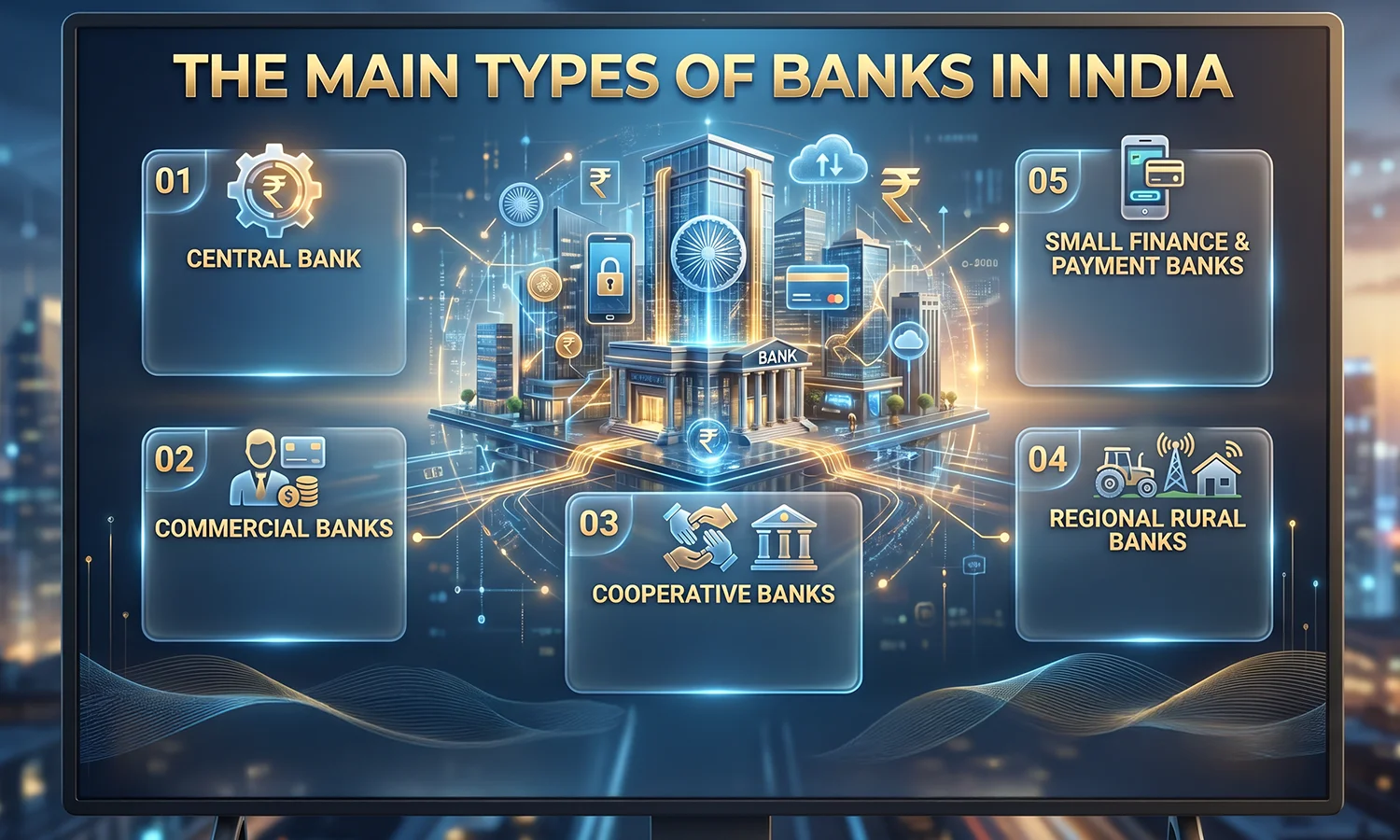
The types of banks in India can be grouped into a few clear categories. At the top sits the central bank, which supervises the entire system. Below it are the banks that the public deals with directly. The structure includes the following groups:
Each category operates under its own licence conditions and serves a specific audience. A payment bank, for example, cannot give large loans the way a full commercial bank can. These limits are set on purpose so that each institution stays focused on the role it was created to play.

What Is a Commercial Bank?

A commercial bank is the type that most people interact with. The simplest commercial bank meaning is an institution that accepts public deposits and lends that money out to earn interest. When someone asks what is commercial bank, the honest answer is the everyday bank that holds a salary account, issues a debit card, and offers home or business loans.
Commercial banks in India fall into public sector, private sector, and foreign bank groups. The ownership differs across these groups, but the core service they provide stays the same. They take money from people who want to save and pass it to people who want to borrow.

Functions of Commercial Banks

The functions of commercial banks go well beyond simply holding deposits. These banks are the main engine of credit in the economy, and their daily work touches almost every household and business.
There are also different types of commercial banks based on ownership and scale. A scheduled commercial bank is one listed in the second schedule of the central bank’s governing act. This status gives the bank access to certain facilities and signals a higher level of regulatory oversight, which matters because it affects how the bank borrows and how customers trust it.

The Role of the Central Bank

Sitting above every commercial bank is the central bank, which in India is the Reserve Bank of India. The functions of central bank are very different from those of an ordinary bank because it does not serve the general public at all. Instead, it manages the currency, guides interest rates, and protects the stability of the whole system.

When the central bank changes a key rate, every commercial bank feels the effect, and so do borrowers and savers across the country. This is why its decisions are watched so closely by markets and the media.

Why Knowing the Types of Banks Helps Your Career

For anyone building a career in finance, understanding the types of banks is more than an exam topic. Each category hires for different roles and rewards different strengths. A commercial bank often needs strong service and relationship staff, while a rural bank values knowledge of local lending. Knowing where you fit helps you choose the right training and aim at the right opportunities. A clear grasp of the structure also makes you a more confident professional from your very first day on the job.

How These Banks Work Together

The different types of banks do not operate in isolation. They form a connected network where money and information flow between them every day. A commercial bank, for example, keeps reserves with the central bank and follows the rules it sets. A cooperative bank may rely on larger banks for certain services it cannot provide alone.
This cooperation keeps the system efficient and stable. When each institution focuses on what it does best, the whole network serves more people at a lower cost. A farmer in a village and a company in a city can both find the right support because the structure was designed to reach them both.

A Quick Way to Remember the Categories

If the list feels like a lot to hold in your mind, a simple method helps. Think of the central bank as the manager, the commercial banks as the main workforce, and the smaller banks as specialists who serve specific groups. This picture makes the structure easy to recall.
With that mental map in place, the differences between the various types of banks become clear. You can place any new bank you hear about into one of these groups and understand its role at once.

India’s banking system works because each institution has a defined job. From the central bank that shapes policy to the commercial banks that serve millions of customers, every layer supports the next. Once you understand these categories, the financial world becomes far easier to read and far less intimidating. To learn more about banking concepts and professional growth in the BFSI sector, visit srmsb.com for more.

FAQs

The main types of banks in India include the central bank, commercial banks, cooperative banks, regional rural banks, and newer small finance and payment banks. Each one serves a different group of customers under its own set of rules.
The simplest commercial bank meaning is an institution that accepts public deposits and lends that money to earn interest. When people ask what is commercial bank, the answer is the everyday bank used for salary accounts, cards, and loans.
The main functions of commercial bank work include accepting deposits, lending money, offering payment services, and creating credit. These roles make commercial banks the main engine of credit in the economy.
A scheduled commercial bank is one listed in the second schedule of the central bank’s governing act. This status gives it access to certain facilities and signals a higher level of regulatory oversight.
The functions of central bank include issuing currency, setting monetary policy, supervising other banks, and acting as the lender of last resort. The central bank guides and protects the whole banking system.