
Bank Jobs

How to Land Entry Level Bank Jobs with No Experience: A Step-by-Step Guide

Key Takeaways

Introduction

Getting entry-level bank jobs can feel hard when your resume has no work experience. But here’s the truth: many banks hire freshers every month. They just want people who look ready to learn, speak clearly, and understand the role. In this guide, you’ll learn what entry-level bank jobs really are, what you need to qualify, and a simple step-by-step plan to get selected even if you are starting from zero.

What Are Entry-Level Bank Jobs?

Entry-level bank jobs are starting roles in a bank where you learn the work on the job. These roles usually involve helping customers, doing basic operations, supporting sales, or handling documents. Banks use these roles to build their future team.
The best part is this: in many cases, banks do not expect you to know everything from day one. If you’re looking for bank jobs for freshers, they mainly check if you can learn fast, behave professionally, and handle simple tasks without panic.

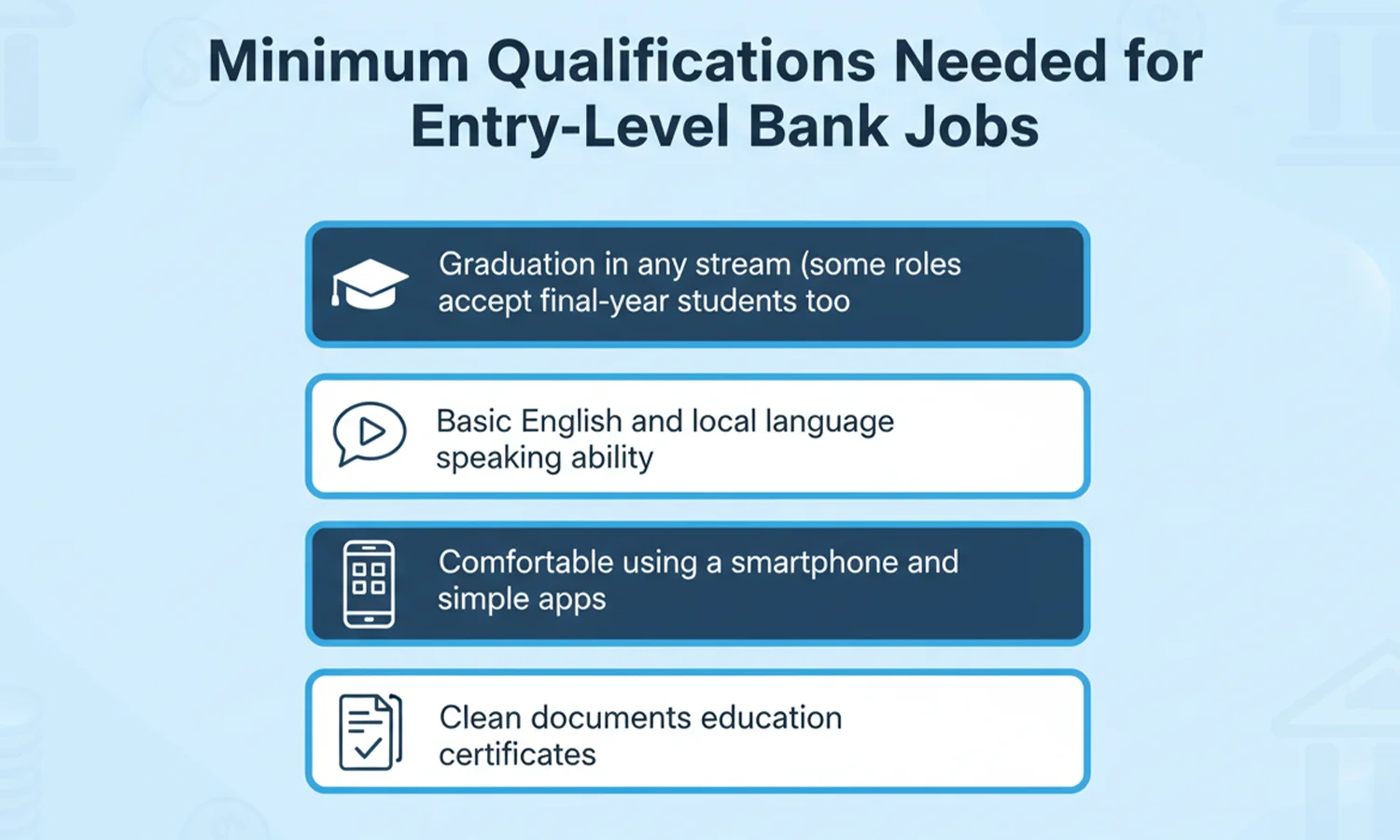
Minimum Qualifications Needed for Entry-Level Bank Jobs
Entry Level Bank Jobs

Most entry-level bank jobs have simple requirements. The exact criteria change by role and company, but these are common basics:

Some entry-level bank jobs also prefer candidates who have basic knowledge of accounts, KYC, and customer service.

Entry-Level Bank Jobs You Can Get Without Prior Work Experience

Aim for entry-level bank jobs where freshers are welcomed. Many entry-level bank jobs fall into these categories:
If you prefer desk roles, you can also target back-office bank jobs that focus on entries, verification, and processing. These roles need patience, accuracy, and basic system comfort.

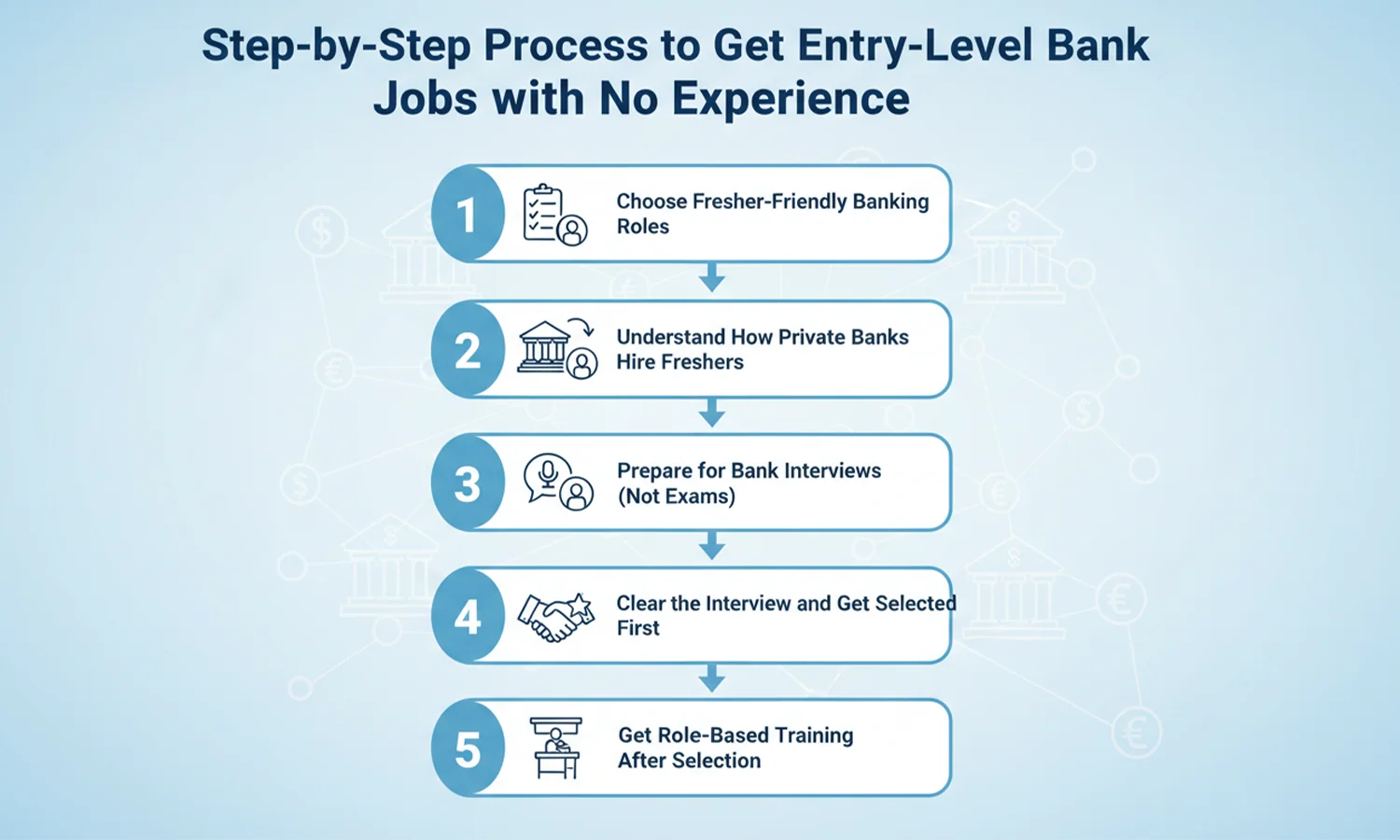
Step-by-Step Process to Get Entry-Level Bank Jobs with No Experience
Entry Level Bank Jobs

Step 1 – Choose Fresher-Friendly Banking Roles

Start by choosing roles where hiring is active and training is possible. Many freshers make one mistake: they apply everywhere without knowing what the job is. Then, they fail the interview because they can’t explain why they want that role.

Shortlist 2–3 roles and learn what they do in their daily work. This gives you clarity, and it shows in your answers when you apply for entry-level bank jobs.

Step 2 – Understand How Private Banks Hire Freshers

Most hiring for beginner roles is fast. In many cases, banks hire through walk-ins, referrals, partner drives, or campus-style shortlisting. This is common in private sector bank jobs, especially for branch sales and service roles.

You don’t always need a long test. Many hiring processes focus on communication, confidence, and basic role awareness. Once you understand this, you stop wasting time preparing like it’s a government exam, and you focus on what actually gets you selected for entry-level bank jobs.

Step 3 – Prepare for Bank Interviews (Not Exams)

For many entry-level bank jobs, interviews decide everything. So prepare like a working professional, not like a student. Here’s what to do:

You can also do a short banking course if you need help with the basics and confidence. It makes your answers cleaner and your role understanding stronger.

Step 4 – Clear the Interview and Get Selected First

In fresher hiring, selection often depends on small things. Make sure you do these right:

If you’re applying to Private bank jobs, remember that HR looks for people who can speak well and handle customers without attitude. Even if you are nervous, keep your tone calm. That alone can push you ahead in entry-level bank jobs.

Step 5 – Get Role-Based Training After Selection

Training like this helps freshers settle into entry-level bank jobs without feeling lost in the first few weeks.
For example, Mahindra Finance’s SRM School of Banking partner page mentions that candidates are selected jointly, receive a provisional offer letter on registering, and then go through a one-month online training program; it also lists a program fee of ₹30,000 + 18% GST.

How SRM School of Banking Helps Freshers Get Entry-Level Bank Jobs

SRM School of Banking works with partner recruiters in some programs where candidates are shortlisted and then trained for the role before joining. One such official partner listing (Mahindra Finance) clearly shows the structure: joint selection, registration after a provisional offer, and training conducted by SRM School of Banking with a stated fee on the partner page.
If you want a structured route, a Job Assured Banking Program can help you move from “student mode” to “job mode” faster, so you feel prepared for the work you will actually do.

Conclusion

If you focus on learning the role, speaking clearly, and showing a professional mindset, entry level bank jobs become much easier to land. And if you want guided training that matches what recruiters expect, SRM School of Banking can be a practical option in partner-based hiring setups.

FAQs

Absolutely; most private institutions prioritize your “trainability” and communication skills over a past resume, often using a Job Assured Banking Program to bridge the gap.
Customer Service Executive and Relationship Officer roles are the most accessible bank jobs for freshers because they focus on your personality and professional mindset.
Not necessarily; while government roles require them, you can secure many private sector bank jobs through direct interviews and partner-led training programs without any national exams.
Yes, many banks and partners like the SRM School of Banking allow final-year students to apply, provided they complete their degree requirements before the official onboarding starts.