
Key Takeaways
- Direct bank job applications work best if you’re already interview-ready.
- A Job Assured Banking Program cuts confusion by linking hiring with training.
- Trained freshers usually get faster placement in private bank job vacancy drives.
What Freshers Must Know About Bank Job Vacancies in Leading Banks
If you are wondering which option works best when comparing a bank job vs banking course, a direct bank job vacancy route looks easy on paper: apply, attend interviews, and get selected. However, when looking for private bank jobs, recruiters hire fast and expect job-ready skills right from day one. Freshers often lose out because they don’t know daily banking tasks, struggle to answer interview questions, or lack confidence in customer scenarios.
Many roles in bank jobs for freshers depend on performance, not just marks. Recruiters focus more on your communication skills, comfort with digital tools, and attitude. If you are confident, you can apply directly, but if not, a support-based training path can help you prepare better before applying.
What Is a Job-Assured Banking Course and How Does It Work?
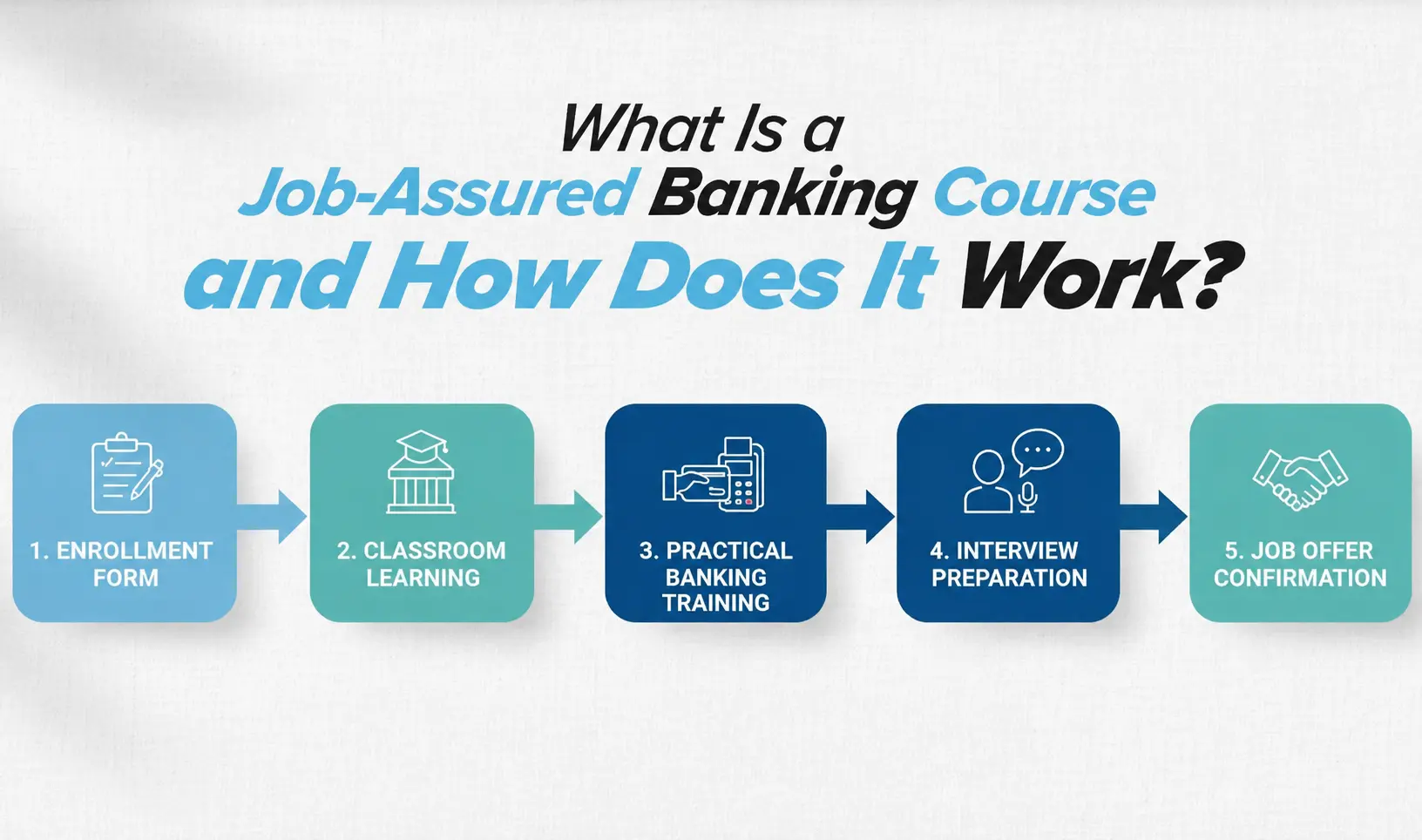
When deciding between a bank job or banking course, it helps to understand how job-assured training programs actually operate:
- Banks first conduct interviews and shortlist candidates for a private bank job vacancy.
- Selected candidates then join a short, focused banking course with placement support.
- Training covers branch operations, customer handling, basic loan work, sales readiness, and workplace grooming.
- After training, candidates join the bank in the role they were already hired for.
- In SRM School of Banking’s model, freshers pay a training fee for the short orientation, and if they complete one year in the role, that amount is returned by the bank (ROI in real terms).
Key Differences between a Direct Bank Job Application and a Job-Assured Banking Course
Feature | Direct Bank Job Application | Job-Assured Banking Course |
Hiring Process | Requires self-applying to multiple banks. Process can take months. | Direct route with upfront partner bank interviews and selection. |
Workplace Readiness | Depends entirely on your current skills and confidence. | Includes upfront orientation in daily branch tasks and skills. |
Early Growth | Steeper learning curve upon joining without pre-job training. | Quicker onboarding and faster performance growth in years 1–2. |
Investment & Risk | Low upfront cost, but higher risk of long job searches. | Requires a training fee but removes job-hunting uncertainty. |
Which Option Offers Better Job Security, Salary & Career Growth?
Let’s keep it simple. If it comes to bank job vs banking course ,direct applications give you freedom; you can apply to many banks and roles. But the risk is that you may spend weeks or months applying without converting interviews. Job security depends on which bank and role you land, not on the path you choose.
So if your goal is fast placement and a smoother start to your banking career after graduation, a structured banking course route can be safer. If you are already confident with interviews and basics, direct applications save time and cost.
How SRM School of Banking Helps You Get Placed in Leading Banks Faster
SRM School of Banking is known for bridging graduation and job readiness through practical training, mock interviews, and placement-linked programs offering top private bank jobs. (YouTube)
Because banks are already involved in hiring, the placement process becomes faster and more direct. For freshers who are choosing between a bank job or banking course and wanting a quicker start in banking without long job hunting cycles, this model makes the path clearer.

